Customer Feedback Management: A Request-to-Adoption Test

A customer asks for a better way to invite teammates. Support records the request, sales hears the same problem from another account, and a founder adds it to a planning document. Three months later, the team ships an improved invitation flow. Who knows which customers asked for it? Who tells them? And can anyone tell whether they started using it?
Those questions are a useful way to evaluate customer feedback management software. An inbox can preserve messages. A management tool should preserve the connection between a customer's problem, the product decision, the release, and what happened afterward.
What should a customer feedback management tool do?
A customer feedback management tool should help a team group related requests without losing the original customer context, track what happens to each request, and connect the evidence to roadmap decisions. After a change ships, it should help the team identify whom to follow up with and check whether eligible users adopted it.
The test is not how many requests the tool can collect. It is whether the team can answer, without rebuilding the story from several systems: What did customers need, what did we decide, what shipped, and did it help?
Use one real request to compare options. Follow it through these five checks:
| Check | What to look for | Warning sign |
|---|---|---|
| Requests | Related feedback can be grouped while the original comments, sources, and accounts remain visible. | Similar requests sit in separate inbox threads or get merged into a vague feature label. |
| Prioritization | The team can compare customer problems and record why it chose to act, wait, or decline. | Vote totals or the loudest recent conversation stand in for a decision. |
| Status and roadmap | Request status reflects a clear decision and can be connected to planned product work. | Someone must update a request list and roadmap separately. |
| Release follow-up | The team can find the people who asked and communicate what changed. | A changelog goes out, but nobody can identify whom to contact. |
| User adoption | The team can check whether the relevant users performed the intended action after release. | A request is marked "done" as soon as the code ships. |
These checks separate collection from management. You may not need every step in one application, but you do need a dependable way to carry context across each handoff.
Start with request grouping, not a feature wishlist
Customers often describe the same problem in different language. One says invitations are confusing. Another asks for a new member role. A third says their administrator cannot tell whether an invite was accepted. Those comments might point to one workflow, or they might need different solutions.
In a trial, enter all three as separate pieces of feedback. Then try to group them around the underlying problem without erasing their differences. Can you still read each customer's words? Can you see which account reported which issue and where it came from? Can you split the group later if investigation reveals two distinct problems?
This matters because a tidy request count can hide weak evidence. Ten people asking for "better permissions" may be describing ten different obstacles. Conversely, a single account may provide a detailed example of a serious blocker. A useful tool makes those distinctions easier to examine rather than turning every comment into a vote for a prewritten solution.
Account context is especially important for a B2B SaaS team. Before deciding what to build, the team should be able to ask who encounters the problem, what task they are trying to complete, and whether the account has reported it before. Preserve that context when feedback moves into planning; otherwise, the roadmap item becomes detached from the reason it exists.
Make status explain the decision
A status such as "under review" is only useful if someone owns the review and knows what should happen next. During evaluation, take a grouped request through several realistic outcomes: investigate it, link it to planned work, defer it, and decline it. Check whether teammates can understand the current position without reading a private chat thread.
Keep customer-facing language separate from internal delivery detail. "Considering" can be honest when a team is still investigating. "Planned for next month" is a commitment that may be premature. A management tool should make it practical to record a decision without forcing the team to promise a date it cannot support.
Then test roadmap linkage. Open a planned item and ask: can you get back to the supporting customer comments and account context? Open the original request and ask: can you see what product work it informed? If either direction requires searching another application and guessing which entries match, the link is too fragile for routine use.
Managani's customer feedback workflow is built around carrying requests into prioritization and roadmap planning. The point of that connection is to keep the customer problem available when the team makes and revisits a product decision.
Why teams outgrow a standalone inbox
A standalone inbox can be the right choice when feedback volume is low and someone already maintains a reliable path from requests to planning and follow-up. It may also fit a team whose main need is to respond to individual messages, not coordinate product changes.
The limit appears when the same request has to be recreated at each stage. A teammate copies a support message into a planning board. Another person rewrites the roadmap update. After launch, someone searches old conversations to find interested customers. Then the team opens a separate report to check usage, without knowing whether those users were the ones who asked.
The issue is not that an inbox lacks enough fields. It is that the team spends time restoring context each time work changes hands. If this sounds familiar, compare software using the full request-to-release workflow rather than buying the inbox with the most collection channels. For more on managing the decision itself, see the feature request management guide.
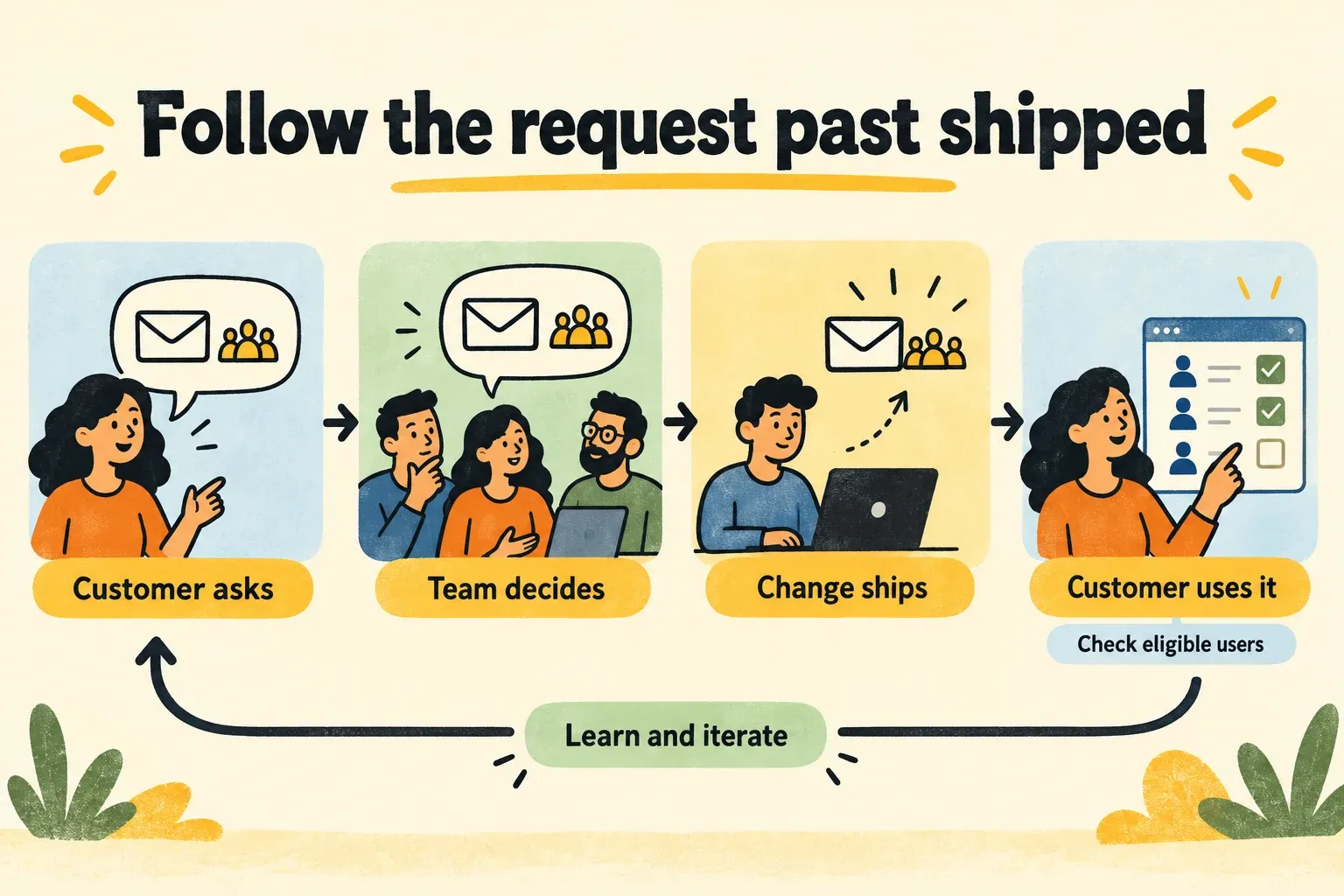
Do not stop the test when a feature ships
Suppose the team releases that improved invitation flow. The next test is whether the tool helps you find the accounts that raised the problem and prepare an accurate follow-up. A release note can explain what changed, but an account that described a specific blocker may need a more direct response. "We shipped it" is also not enough if the change addresses only part of what they requested.
After communication, define the behavior that would show the release helped. For the invitation example, that might be an eligible administrator completing an invitation, rather than merely viewing a release announcement. Compare that behavior among users who had access to the change, and ask affected customers whether their original obstacle remains.
Do not treat message views as adoption. Do not treat low usage as proof the feature was unnecessary, either. Users may not know the change exists, may lack access, or may still encounter a confusing step. Tracking product events after a release can show what people did; the original feedback helps explain what the team hoped would change.
Managani connects feedback, roadmap work, changelog updates, onboarding guidance, and product-usage tracking in one product workflow. That is relevant if your evaluation extends beyond collecting requests to helping users discover a shipped change and checking whether they use it. Its tracking is about product behavior and adoption, not general website traffic.
Run one end-to-end trial before choosing
Pick a recent request with at least two customer comments and a known product decision. If possible, choose one that has already shipped. Use the same example in every tool you assess:
- Add each original comment with its account context.
- Group the comments without losing their distinct details.
- Record the decision and its reason, including who owns the next step.
- Connect the request to roadmap work and check the link in both directions.
- Find the customers who need an update when the change ships.
- Identify one user action that would show whether the release addressed the problem.
Note where you leave the tool, copy information, or ask a colleague to reconstruct the history. Those handoffs are part of the cost, even if the subscription looks inexpensive.
For a lean SaaS team, Managani is worth evaluating when those handoffs are the problem you want to solve. It is available as a managed beta; the open-source release and self-hosting plan applies when it leaves beta. Whichever tool you choose, keep the purchase criterion concrete: a customer request should remain understandable from first report through decision, release, follow-up, and use.