Best Product Roadmap Software for SaaS Teams to Compare in 2026

A roadmap tool should make product direction easier to understand and update. For a SaaS team, it may also need to connect customer requests to decisions, delivery work, release updates, and what happens after launch. The right choice depends on which of those jobs is slowing your team down.
This comparison covers Jira Product Discovery, Productboard, Userorbit, Aha!, airfocus, Canny, and ProductPlan. The shortlist matches the products named in this 2026 product roadmap software roundup. Treat the descriptions below as starting points for evaluation, not as a substitute for checking current plans and capabilities with each vendor.
Best product roadmap software at a glance
| Product | Consider it when | Check before choosing |
|---|---|---|
| Jira Product Discovery | Your team wants product discovery and roadmap planning close to Jira delivery work. | Whether the discovery workflow works for non-Jira users and how roadmap context moves into delivery. |
| Productboard | You want product planning informed by customer feedback and prioritization. | Whether the feedback model, views, and workflow fit your team, and what is included in the plan you need. |
| Userorbit | You are evaluating a SaaS-focused roadmap option alongside established product tools. | Test the actual roadmap workflow, customer input handling, collaboration, and connections to your current stack. |
| Aha! | You need a dedicated product planning tool and want to assess its planning and roadmap scope. | How much of the product's planning depth your team will use, and the setup and administration it requires. |
| airfocus | You want to evaluate a product management platform for prioritization and roadmap planning. | Whether its approach to prioritization and configuration suits your decision process. |
| Canny | You want to manage feature requests and make product direction visible to customers. | How well feedback workflows connect to internal planning and delivery. |
| ProductPlan | Roadmap creation and communication are central needs. | Whether updates, audience-specific views, and handoffs to delivery fit your process. |
There is no universal winner. A team that needs a clear roadmap for customers may value different capabilities from a team deciding which requests merit investment or coordinating discovery with engineering.
How to choose a roadmap tool
Start with the decision or handoff you need the software to improve. A feature checklist matters less if the product does not fit how your team makes and communicates decisions.
1. Decide who the roadmap is for
An internal roadmap may include assumptions, evidence, dependencies, and uncertainty. A customer-facing roadmap needs clear language and careful promises. Some teams need both, with different levels of detail for each audience.
Before comparing tools, list the people who need to use or view the roadmap: product managers, engineers, executives, customer-facing teams, or customers. Then check whether each product supports those audiences without forcing the same view on everyone.
A roadmap should communicate direction, not create an accidental delivery guarantee. For examples of different formats and audiences, see seven product roadmap examples.
2. Trace how customer evidence reaches a decision
If requests arrive through support, sales calls, surveys, or in-product feedback, ask how that evidence gets considered during prioritization. Can the team preserve the customer context behind a request? Can related requests be reviewed together? Can a roadmap item show why it matters?
Do not count votes as the whole decision. Demand signals can help identify patterns, but they need to be weighed against product goals, customer impact, effort, and other evidence. If feedback management is a major part of your evaluation, compare the roadmap workflow with the team's customer feedback tool requirements.
3. Check the path from roadmap to delivery
A roadmap communicates intent. It is not automatically a delivery plan, sprint board, or engineering workflow. Find out whether a tool connects to the systems your developers already use, what information is synchronized, and which updates still require manual work.
For teams already using Jira, proximity to Jira may be a reason to evaluate Jira Product Discovery. For any tool, test a real example: take one roadmap item through discussion, prioritization, delivery handoff, and status update. A demo with a simplified sample can hide the work involved in keeping two systems aligned.
4. Look for a useful level of detail
Roadmap items can be organized around outcomes, themes, features, or time periods. A tool should support the level of detail your team can maintain. If every idea needs a precise date before there is enough evidence, the roadmap can imply more certainty than the team has.
Ask how easy it is to show confidence, revise plans, and explain a change. Also check whether the roadmap can stay readable as the team adds initiatives. More fields and views are only useful if they help people make or understand a decision.
5. Include what happens after shipping
A roadmap item does not finish the product work. Once a feature ships, the team may need to announce it, guide users to it, and check whether it is being adopted. If those jobs live elsewhere, see how the roadmap connects to release communication and product usage data.
For SaaS teams, this distinction matters: a delivered item is not necessarily a successful one. Tracking product adoption can help teams ask whether users reached and repeated the behavior the feature was meant to support.

Product-by-product comparison
Jira Product Discovery
Jira Product Discovery is worth evaluating when product discovery should sit close to Jira-based delivery. The potential advantage is reducing distance between product decisions and engineering work. The key test is whether discovery remains accessible and useful to everyone who contributes, not only people who work in Jira every day.
During a trial, follow a real idea from its evidence and discussion into delivery. Check what context is retained, whether status needs to be updated in more than one place, and how non-engineering stakeholders see progress.
Productboard
Productboard is a candidate for teams that want customer feedback and product prioritization to inform roadmaps. It may suit teams where product managers regularly synthesize customer input before deciding what to plan.
Evaluate the workflow with actual requests from your team. Can people see the evidence behind a priority? Can the team connect a broad customer problem to a proposed outcome without treating every request as a separate roadmap commitment? If you are comparing it against other prioritization tools, see this related guide to Productboard alternatives.
Userorbit
Userorbit is included in the 2026 comparison set, so it belongs on the shortlist if you are assessing SaaS roadmap products. The available information here is not enough to make a detailed feature or pricing comparison. Evaluate it directly against the workflow your team needs rather than assuming that its category or positioning guarantees a particular capability.
Ask for a walkthrough using a representative roadmap: include a customer signal, a decision, a delivery handoff, and a change in direction. Confirm which parts are native to the product, what depends on integrations, and whether the plan you would buy supports the intended use.
Aha!
Aha! is another product to consider when you are looking for dedicated product planning and roadmap software. It may be a fit for teams that need more than a lightweight view of upcoming work, but additional planning depth is valuable only if it matches the team's process.
In an evaluation, have the people who will maintain the roadmap build a real planning view. Note how much setup is needed, which fields and workflows are essential, and whether stakeholders can understand the result without a product manager explaining every item.
airfocus
airfocus is worth assessing when prioritization and roadmap planning are both on the requirements list. Compare its approach with the way your team currently makes decisions. A scoring model can make trade-offs easier to discuss, but it cannot determine what matters without clear criteria and good evidence.
Before adopting a model, agree on what the team is optimizing for. Then test whether the tool helps compare initiatives consistently, while still allowing people to explain exceptions or uncertainty.
Canny
Canny is a candidate when feature requests and customer-facing product communication are important parts of the roadmap workflow. It is especially important to check where feedback work ends and internal planning begins.
Try the process with requests that are similar but not identical. See whether your team can preserve the underlying customer problem, explain why an idea is planned or deferred, and keep the public view accurate as priorities change. If roadmap planning needs a deep delivery workflow, assess that separately rather than assuming request management covers it.
ProductPlan
ProductPlan is worth comparing when creating and communicating roadmaps is the central job. Test whether the views are easy for each audience to understand and whether they can be kept current without duplicating a large amount of information from delivery tools.
Use an actual initiative to check how the team will represent timing, confidence, and changes. If dates are provisional, make sure the roadmap can communicate that clearly. If the team needs feedback-driven prioritization or adoption tracking, confirm how those workflows connect or whether they will remain in other systems.
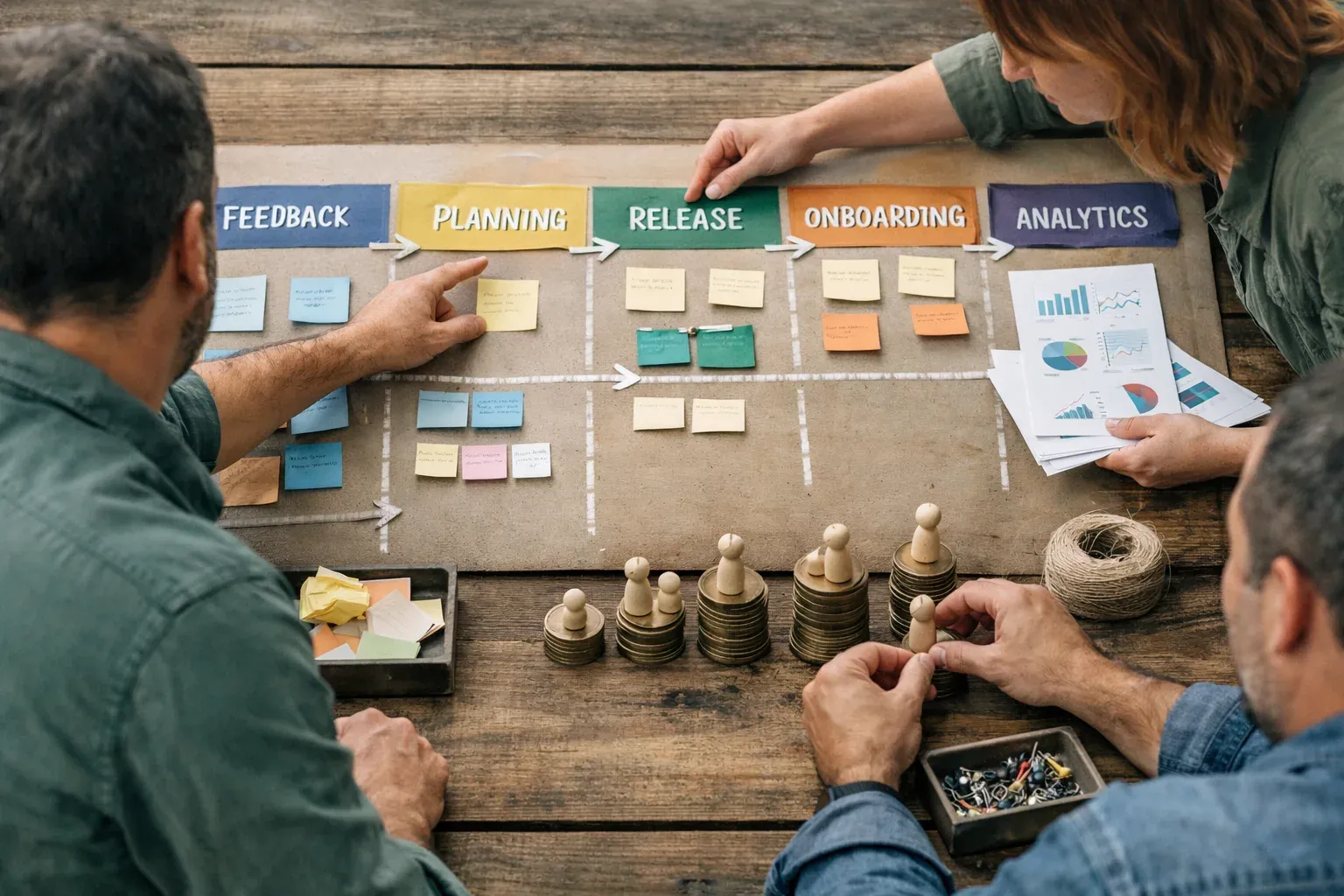
Consider a connected product workflow, not just a roadmap
Some SaaS teams are not looking for another standalone roadmap. Their friction comes from copying context between feedback, planning, release communication, onboarding, and analytics. In that case, compare the cost of keeping separate tools connected with the value of a broader product workflow.
Managani is a product experience platform for lean SaaS teams. It connects feedback, prioritization, roadmaps, changelogs, onboarding, in-app messaging, analytics, and adoption tracking in one workspace. That makes it relevant when the goal is to carry product context from customer signal through release and adoption, rather than only to create roadmap views.
This is a different evaluation from choosing a specialist roadmapping product. Confirm that the capabilities your team depends on are supported before treating a broader platform as a replacement for dedicated roadmap or delivery software.
Make the decision with a short pilot
Choose two or three tools that match your main need and test them with the same initiative. Use one current customer problem and follow it through:
- Record the evidence behind the problem, including who raised it and what they were trying to do.
- Show how the team compares it with other priorities and records the decision.
- Create a roadmap view for the audience that needs to understand the plan.
- Trace how the item moves into delivery and how changes are reflected.
- Define what the team will communicate when it ships and how it will check adoption.
After the pilot, compare not just the finished roadmaps but the effort required to keep them accurate. Ask the people who supplied feedback, made decisions, delivered the work, and communicated the release whether the tool preserved the context they needed.
The best product roadmap software for your SaaS team is the option that fits its actual planning audience and decision process, without creating more manual handoffs than it removes. If roadmap communication is the main gap, prioritize clarity and audience views. If customer evidence is disconnected from decisions, focus on feedback and prioritization. If the team loses the thread after shipping, evaluate how roadmap work connects to release communication and adoption.