Growth Loops: How to Build the Full Growth Loop Without Tool Sprawl
A growth loop only works when every step feeds the next one. If feedback lives in one place, roadmap decisions in another, release notes somewhere else, and adoption data in a different tool, the loop breaks at the exact moment it should start compounding.
That is the problem Managani is built around. It gives product teams one place to hear users, decide what to build, ship the change, guide people to the new behavior, and measure what happened next.
What is a growth loop?
A growth loop is a repeatable system where one action creates the next one. Instead of growth relying on a one-time campaign, a loop turns product work into a cycle that keeps producing signals, decisions, and adoption.
In product teams, the loop usually looks like this:
- users find your product
- they use it and hit friction
- they send feedback or support context
- the team decides what to change
- the team ships the change
- users are told about it and guided through it
- usage data shows whether the change worked
- the result feeds the next decision
That is the difference between a product that “launches features” and a product that keeps learning.
The full growth loop
A lot of teams talk about loops, but stop at feedback or roadmap planning. The full growth loop runs all the way from attraction to measurement.
Here is the version that matters for SaaS teams:
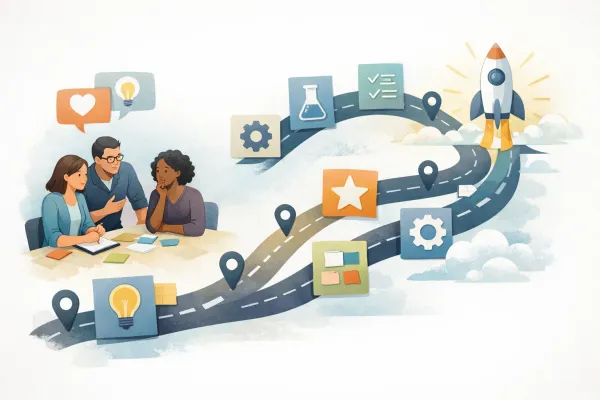
Attract → Listen → Decide → Ship → Guide → Measure → Learn again
If one step is disconnected, the loop loses speed. If all six steps sit in one workflow, each release becomes the input for the next one.
1. Attract the right users
The loop starts before signup. You need the right people to find the product in the first place, and Managani’s features page reflects that with a “Reach” layer for content strategy and social signals.
This matters because poor-fit users create noisy feedback. Good-fit users create useful signals. If the wrong audience comes in, the team ends up optimizing around confusion instead of product value.
For most SaaS teams, attraction is not about chasing traffic for its own sake. It is about bringing in users whose jobs match what the product can actually solve.
2. Listen to what users are telling you
Once users are inside the product, the loop depends on feedback. That can come through a dedicated feedback inbox, in-app chat, surveys, support replies, or a mix of all four.
Managani keeps those signals tied to the account context that explains why the request matters. That is the difference between “please add X” and “this customer needs X because their team is blocked in Y workflow.”
Listening is not just collecting more requests. It is sorting signal from noise:
- bugs that block usage
- feature requests that point to a missing workflow
- praise that shows what users value
- satisfaction or churn risk that signals where to dig deeper
If feedback is separated from the rest of the product loop, it becomes a pile of ideas instead of a source of decisions.
3. Decide what to build
The next step is deciding. This is where a growth loop becomes a product growth system instead of an inbox.
Teams often make this step too abstract. Requests get logged, reviewed later, and discussed in a separate planning tool. By the time a decision is made, the context is stale.
A better approach is to keep the request, the account, the reason, and the decision together. That makes prioritization faster and clearer. It also makes roadmap choices easier to explain later, because the team can see what signal led to the call.
This is where a product growth platform matters. Managani’s roadmap layer is meant to sit next to feedback, not far away from it.
4. Ship the change
Shipping is not the end of the loop. It is the handoff point.
A lot of teams treat release work as the final step because the code is merged and the feature is live. But if users do not know what changed, or cannot find the new behavior, the feature may as well still be hidden.
That is why the shipping step has to include communication. A changelog, release note, or what’s-new message tells users that something changed and why it matters.
In the loop, shipping should answer two questions:
- what changed?
- what should users do now?
If you only answer the first one, users may ignore the release. If you answer both, the product can start moving behavior.
5. Guide users to the new behavior
This is the step most teams skip.
A feature can be live and still not adopted. Users may not notice it, may not understand it, or may not know when to use it. That is why guidance belongs in the loop alongside releases.
Managani includes chat, tours, and highlights for this reason. They help turn a shipped change into a visible behavior change. A tour can introduce a new flow. A highlight can point people at a new action. Chat can help when users get stuck in the moment.
This is where growth loops become compounding loops. The product does not just publish updates. It moves users toward the update.
6. Measure what happened
The loop closes with measurement.
You need to know whether the release changed behavior, not just whether it shipped. That means looking at usage after the rollout, not only at delivery status.
Useful questions include:
- Did users try the new feature?
- Did adoption increase after the release note or tour?
- Did the new flow reduce support requests?
- Did feedback improve after the change?
- Did the usage pattern match the original request?
Tracking is what turns product work into learning. Without it, the team hears complaints and ships fixes, but never sees whether the fixes worked.
Managani’s tracking layer is designed to sit inside the product story, so the team can connect the request, the release, and the result.
Why growth loops break in fragmented stacks
Most product teams do not lack tools. They have too many.
One tool captures feedback. Another handles the roadmap. Another sends changelogs. Another runs onboarding. Another tracks usage. Each one is useful on its own, but the story gets split across systems.
That creates three problems:
- Context gets lost: the reason behind the request disappears when feedback leaves the planning workflow.
- Hand-offs slow everything down: every release requires moving information between tools.
- Learning stops at launch: teams can see what shipped, but not whether it changed behavior.
That is why Managani positions itself as a unified product growth platform. The point is not more software. The point is a tighter loop.
What a full growth loop looks like in practice
Here is a simple example.
A customer asks for a way to reduce setup friction. That request lands in feedback with account context attached. The product team decides to prioritize a small onboarding improvement. They ship it, announce it in the changelog, and add a guided tour so users notice the new flow. Then they watch usage to see whether activation improves.
Now the team has more than a release. They have a loop:
- a real signal from a user
- a product decision tied to that signal
- a release that users can see
- guidance that helps adoption
- data that shows whether it worked
That is how the next decision gets better.
Why founders care about the loop
Founders usually feel the loop before they can name it. They see support questions repeat. They see a feature shipped, but not adopted. They see churn reasons overlap with missing product behavior.
The problem is not just product planning. It is that customer feedback, roadmap work, release communication, onboarding, and tracking are treated as separate jobs.
For a small team, that is expensive in time and focus. For a growing team, it becomes expensive in tool sprawl too.
A full growth loop gives founders one question to answer at each stage: what should happen next, and how do we know it worked?
How Managani supports the full growth loop
Managani is built around the same loop this article describes.
- Reach helps attract the right users with content strategy and social signals
- Guide helps onboard and direct users with chat, tours, and highlights
- Listen captures feedback and surveys with account context
- Ship connects roadmap decisions and changelog updates
- Learn uses tracking to show whether the change landed
That structure matters because it keeps the product story intact. The request, the decision, the release, the nudge, and the usage signal all stay connected.
If you want the broader category framing, see What Is a Product OS? The Operating System for SaaS Product Growth. If you want the stack-replacement angle, read Product Growth Software That Replaces a Fragmented Stack. And if you want the open-source version of the same idea, start with Open Source Product Growth Platform: How to Build the Full Growth Loop Without Tool Sprawl.
The takeaway
A growth loop is not just a strategy term. It is a product operating rhythm.
The full loop is:
Attract → Listen → Decide → Ship → Guide → Measure → Learn again
If those steps live in separate tools, the loop slows down. If they live in one workflow, every release becomes a better input for the next one.
For SaaS teams, that is the point. Not more activity. More learning per release.