Product Growth Keyword Coverage Audit: Give Each Page a Job

A SaaS team searches for "customer feedback management," lands on a product growth article, and has to hunt for the request workflow. Another reader searches for "SaaS onboarding software" and finds the same explanation of feedback, roadmaps, releases, and adoption. Both pages mention the right terms, but neither makes its primary job clear.
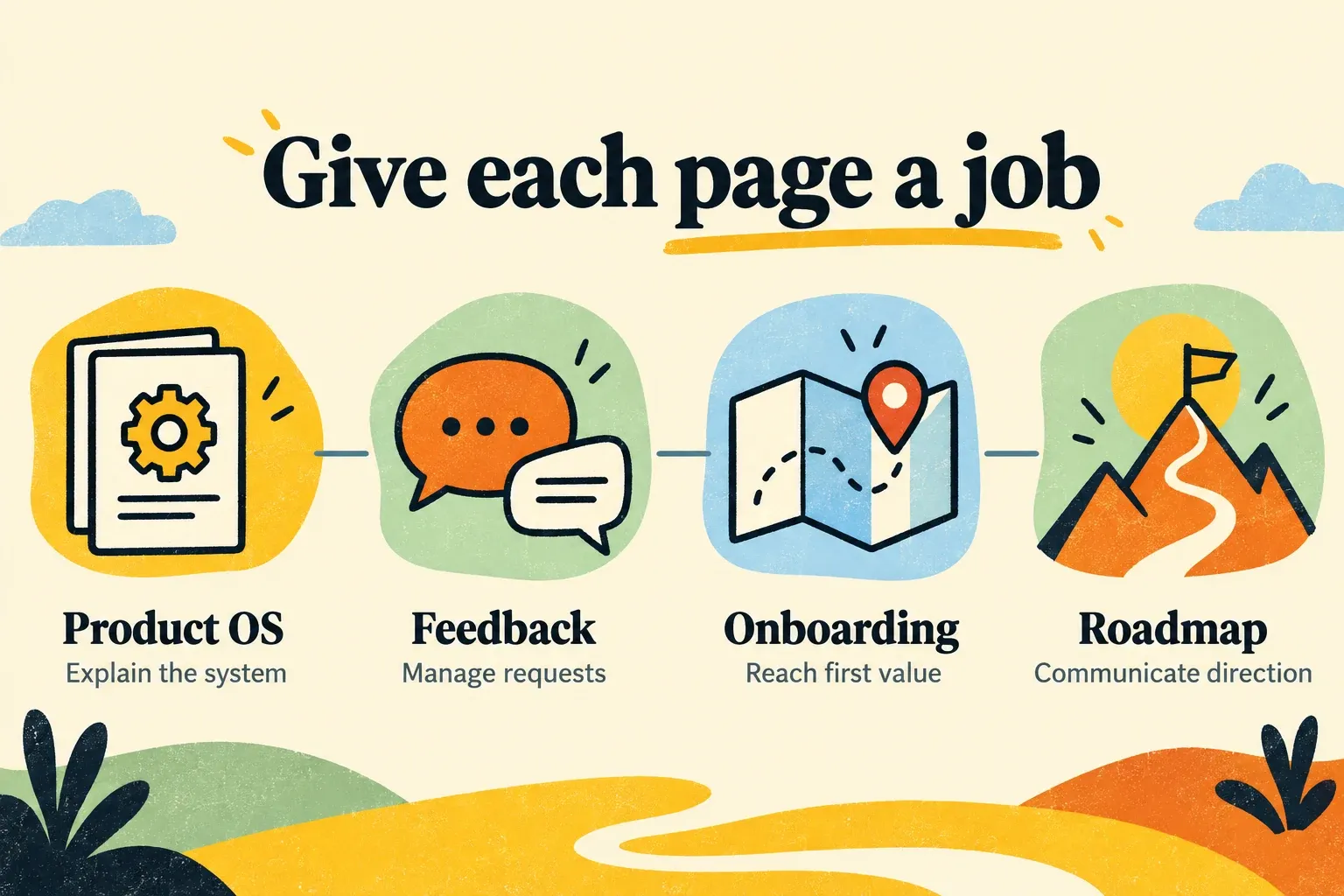
That is the problem a product growth keyword coverage audit should solve. The goal is not to remove every overlapping term. Feedback, onboarding, roadmaps, and changelogs belong in the same product story. The goal is to make one page the best answer to each distinct question, then use internal links to carry readers to the next part of the workflow.
For Managani, the clearest division is:
| Topic | Primary page job | Question it should answer first |
|---|---|---|
| Product OS | Explain the connected system | How do these product-growth workflows fit together? |
| Feedback management | Explain the request workflow | How do we collect, organize, decide on, and follow up on feedback? |
| SaaS onboarding | Explain activation | How do we help users reach a first useful outcome? |
| Product roadmap | Explain planning and direction | How do we communicate priorities without promising uncertain dates? |
| Changelog | Explain release communication | How do we tell customers what shipped and why it matters? |
This is an editorial map, not a claim that any page is currently losing rankings to another. Without Search Console query and landing-page data, the audit can identify overlapping intent and clarify page roles, but it cannot diagnose search-result cannibalization.
Start with the question each page owns
The product OS article should be the cluster's conceptual pillar. A reader arriving there needs to understand why a team might connect customer signals, planning, releases, guidance, and adoption tracking in one operating workflow. It can introduce each component, but it does not need to become a full tutorial on every component.
The customer feedback management workflow has a narrower job. It should help a team move from an incoming request to an informed decision and a response. That means preserving the customer's problem and account context, grouping related requests, recording the decision, and following up when the status changes. A roadmap is relevant because some requests become planned work. It is not the main subject.
The SaaS onboarding article should own the first path to value: what users need to do, where they get stuck, which guidance helps, and how a team checks whether they completed the intended action. Feedback may explain a confusing step, and tracking may show where users stop. Neither should displace activation as the page's central answer.
For roadmap intent, the product roadmap examples page provides a distinct planning angle. A roadmap communicates direction, confidence, and the evidence behind a choice. It is not a list of every request, a sprint board, or a promise that every proposed feature will ship on a particular date.
Changelog content has a different boundary again. Its job is to make a shipped change understandable: what changed, who it helps, and what a customer can do next. An in-app announcement can help people encounter that update at a useful moment, but an announcement is a delivery method, not a substitute for a clear release explanation.
Audit the overlap at the paragraph level
Titles alone will not show where pages compete. Read the introduction, H2s, FAQs, and conclusion of each page, and mark any passage that answers another page's primary question in depth.
A simple test is to ask: If a reader saw only this section, which query would it answer? If a section in the onboarding article could stand alone as a general guide to customer feedback management, shorten it to the context onboarding needs and link to the feedback page. If the product OS pillar gives detailed instructions for setting roadmap statuses, keep the explanation of why roadmap planning belongs in the system and send readers to the planning resource for the how.
Watch for three common types of overlap:
- Repeated definitions: Several pages can briefly define a shared term, but only its owner needs an extended explanation.
- Identical workflow sections: A request-to-release example can connect the cluster. Repeating the same full example on every page makes their purposes harder to distinguish.
- Catch-all FAQs: An onboarding FAQ about activation fits. A long set of unrelated questions about feedback tools, roadmap software, and open source can pull the page away from its main intent.
This does not mean every page must use exclusive vocabulary. A feedback page should mention roadmaps when explaining what happens to a request. An onboarding page should mention releases when explaining how users discover a new feature. The distinction is between necessary context and a second, competing answer.
Give shared examples different endpoints
Consider a customer request for a saved-report feature. The same request can illustrate several page roles without producing five versions of the same article:
- On the feedback page, show how the team records what the customer is trying to accomplish, connects similar requests, and communicates a decision.
- On the roadmap page, show how the team describes the problem and its planning status without turning a possible solution into a firm delivery promise.
- On the changelog page, show how to explain the shipped feature and its practical use.
- On the onboarding page, show how relevant users could be guided toward creating their first saved report.
- On the product OS page, show why keeping those stages connected makes the history of the decision easier to follow.
Each page uses the same product story to answer a different question. That is more useful than restating "collect, plan, ship, guide, measure" in full every time.
Managani's product context makes the distinctions concrete. Its connected workflow includes feedback, roadmap planning, changelogs, onboarding, in-app messaging, and product usage tracking. Tracking here means checking product behavior and adoption, not treating general website traffic as proof that a shipped feature helped users. Likewise, "open source" needs precise wording: Managani is managed during beta, while publication of the complete application under AGPLv3 and documented self-hosting are planned for after beta.
Build links around handoffs, not keyword repetition
Internal links work best where the reader reaches a decision or handoff. In a feedback article, the natural transition is from "we decided to pursue this problem" to roadmap planning. In a roadmap article, it is from "this shipped" to explaining the release. In an onboarding article, it is from "we showed the guidance" to checking whether users completed the intended action.
Use anchors that describe that next job. "See product roadmap examples" tells readers what they will get; repeatedly linking the phrase "product growth platform" from every paragraph does not. The product OS pillar can point outward to the specialist pages, while those pages can link back when a reader needs the broader operating-system context.
Links cannot compensate for unclear page roles. If two pages have near-identical introductions and headings, adding links between them still leaves a reader unsure which one to use. Fix the answer on each page first, then connect the answers.
Decide what to revise before creating another page
The site already has multiple articles on product growth software, feedback management, onboarding, and growth loops. A new page targeting another broad variation of those terms would need a distinct reader task to justify its place. Otherwise, update the best-fitting existing URL.
For each proposed topic, record four things before drafting:
- Reader question: What would someone be trying to decide or do?
- Owner URL: Which existing page should answer that question?
- Missing answer: What practical information does that page lack?
- Supporting links: Which adjacent pages help after the primary answer?
If the owner URL exists, improve its answer, headings, and links. If the question is genuinely different, define the new page's boundary before writing. For example, "how to analyze customer feedback for product decisions" could warrant a focused treatment if existing feedback pages explain collection and management but do not adequately cover analysis. It should not be another general overview of the entire growth loop.
Finally, use search data when it becomes available. Compare which URLs receive impressions for the same query groups, whether their search snippets match their page jobs, and whether visitors reach the intended next page. Do not merge or redirect pages solely because they share terminology. First establish whether they serve the same intent, then check the evidence.
A good product-growth cluster mirrors the way the work happens without making every page describe all of it. Let the product OS explain the system. Let feedback management handle requests, onboarding handle activation, roadmap content handle planning, and changelog content handle releases. Readers can then enter at the question they have and follow a clear path to the next one.