Feedback Management Tool: Keep Customer Requests Traceable

A customer asks for a bulk export in your app. Another asks support for "a way to download everything." A third votes for an export request on a public board. If those signals become three unrelated entries, the team may overcount demand. If they become one entry with no record of who asked or why, the team loses the detail it needs to make a good decision.
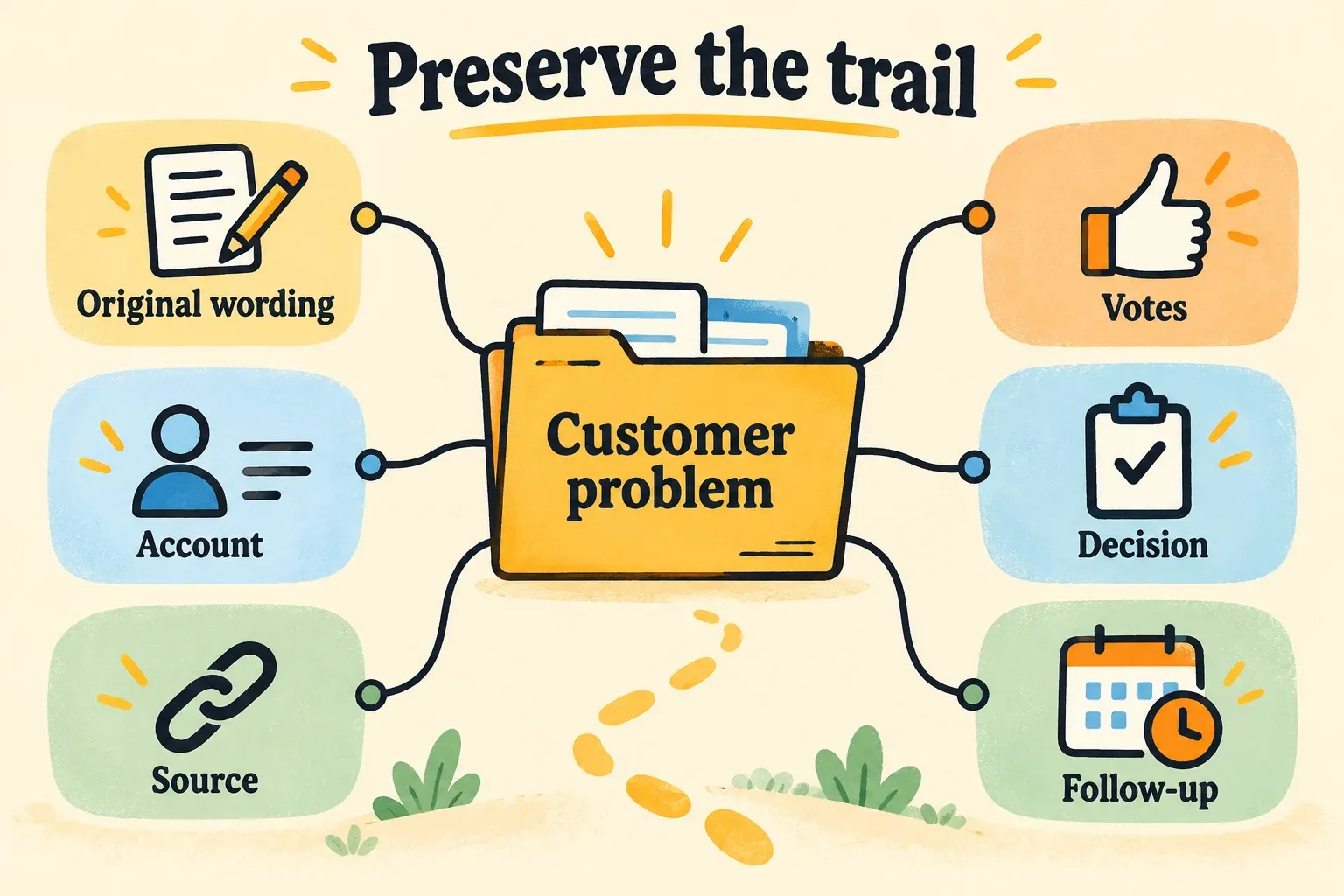
A feedback management tool should do more than collect requests. It should preserve the path from the original customer problem to a product decision, then make it possible to follow up when something changes. That is the useful distinction when comparing a user feedback widget, a feature request board, and a broader product feedback workflow.
What a modern feedback tool should preserve
Use these six questions to compare tools. They test what happens to a request after someone submits it, not just how easy the submission form looks.
| What to preserve | What to check in a demo | What is lost if it disappears |
|---|---|---|
| The original request | Can your team retain the customer's wording, source, and reason for asking? | A short feature label replaces the problem the customer described. |
| Support from other users | Can people vote or add their own context to an existing request? | The team sees either a bare vote count or scattered comments it cannot compare. |
| Duplicate relationships | Can similar requests be grouped without discarding their individual details? | One need appears to be several priorities, or distinct needs are flattened into one. |
| The people following it | Can you identify requesters and subscribers and manage how they hear about changes? | A release goes out, but the people waiting for it are hard to reach. |
| The decision and release | Can the request be connected to roadmap work and a shipped update? | Product, support, and customers each have a different account of its status. |
| Customer and account context | Can the team see which user or account raised a need and the situation behind it? | A count hides whether the problem blocks an important workflow or affects a specific segment. |
These checks do not imply that every vote should determine the roadmap. They help a team keep enough evidence to decide what a request means.
Capture the problem, not only the proposed feature
"Add CSV export" may describe a solution, but it does not explain the job. One customer may need a monthly finance report; another may need a one-time migration. Their proposed feature sounds alike, while the right product response could differ.
Test every capture route your team uses: an in-app widget, a public board, a support conversation, and a request passed along by sales. A useful record should let the team retain the customer's wording and add context such as the affected workflow. The entry point can be lightweight. The information should not have to be reconstructed later.
Treat votes as signals and duplicates as evidence
Voting makes it easier for users to show interest in an existing idea. It is less useful when the number becomes a substitute for understanding the request. Ten votes may represent ten different problems; one detailed request may expose a serious blocker.
Duplicate handling matters for the same reason. Suppose five customers ask for "better exports." Grouping those entries gives product a shared topic to review, but the original notes should remain accessible. Otherwise, the team cannot tell who needs scheduled delivery, who needs a different file format, and who cannot export at all.
A good evaluation exercise is to submit two requests with similar titles but different underlying needs. Try grouping them. Can you still read each customer's reason and separate them again if they do not belong together? For a deeper process for reviewing and prioritizing requests, see the feature request management guide.
Keep identity and subscriptions connected to the request
A public vote count can show interest, but B2B SaaS teams often need to know which customers are affected. Account and user context helps the team investigate a problem, assess its impact, and avoid asking support to find the original conversation.
Subscriptions serve a different purpose. A person may want updates on a request without voting for it, while a colleague may vote but not want every status notification. When comparing tools, check whether you can distinguish requesters, voters, and subscribers; what each person is notified about; and whether the team can control the message.
Do not assume that a tool sends release notifications just because it offers subscriptions. Submit a test request, subscribe a second user, change its status, and inspect the messages both people receive. Check what happens if several requests are grouped under one piece of roadmap work.
Follow the request past "shipped"
A status change is not the same as a customer follow-up. When a feature ships, the team may need to explain what changed, tell the people who asked, and help them find the new behavior. Some requests may be only partly addressed. Others may be declined after review. The feedback record should leave room for an honest update in each case.
This is where a feedback management tool connects to roadmap and changelog work. Managani's customer feedback workflow describes requests captured with account context, organized for prioritization, connected to roadmap items, and reflected in release updates. Its broader product growth workflow also connects releases to onboarding guidance and product usage tracking.
Those connections are useful only if the team uses them. Give each request an owner, record the decision, and identify who will write the customer-facing update. After release, look at whether affected users adopted the change rather than treating a changelog post as proof that the problem is solved. The guide to tracking feature adoption in SaaS covers the usage side of that follow-up.
Run one request through the whole tool before choosing it
A polished feedback board can be easy to demo while leaving the hard handoffs to your team. Test a realistic case from first message to follow-up:
- Submit a request through two channels. Use a widget or board for one user and a support-reported request for another. Check what source and customer detail each record retains.
- Add a vote and a different use case. See whether the second user can explain why they want the change rather than only increasing a counter.
- Group the requests. Confirm that individual wording, identities, and comments remain visible.
- Make a decision. Link the need to a roadmap item, or record why it will not be pursued. Check what customers can see versus what stays internal.
- Simulate a release. Change the status, publish an update, and inspect what the requester, voter, and subscriber receive.
- Check the outcome. Can the team return to the affected accounts and find out whether the shipped change addressed their original problem?
Note every manual step. A standalone user feedback tool may be enough if your team already has reliable ways to carry customer context into planning and release communication. If those handoffs repeatedly lose detail, compare a connected workflow instead of buying another capture surface.
Managani is built around that connected approach: feedback, roadmap planning, changelog updates, onboarding, and adoption tracking sit within its product growth platform. It is currently offered as a managed beta; the open-source plan says the complete application repository and documented self-hosting will follow when beta ends. If you are evaluating it for a specific feedback process, test the capture, grouping, subscription, and notification behavior you need rather than assuming every part of that process works the same way as in your current tool.
The deciding question is practical: after a request is merged, considered, shipped, and announced, can you still tell who raised the problem and whether the change helped them? If the answer is no, the tool has collected feedback without preserving its value.