Product Growth Software That Replaces a Stack

Most teams do not need another isolated tool for one more slice of the product lifecycle. They need product growth software that keeps the loop connected, from the first signal to the shipped change to the adoption check after launch.
That is the case Managani is built for. It brings discovery, activation, shipping, and learning into one workspace so product, design, support, and founders are not stitching together feedback tools, onboarding tools, changelog tools, and analytics tools just to answer a simple question: did the change help?
Product growth software for the full loop
Product growth software is the system a team uses to hear what users need, decide what to build, guide people to value, and measure whether the change worked. In practice, that means more than a feedback inbox or a dashboard.
Managani connects the parts that usually drift apart:
- Listen with feedback and surveys
- Guide with chat, tours, highlights, and contextual prompts
- Ship with roadmap and changelog
- Learn with product tracking and usage signals
- Reach with content and social support for the growth loop
When these jobs live in separate tools, each handoff creates friction. A request gets logged in one place, the roadmap lives somewhere else, release notes are written later, onboarding is patched together in another app, and tracking sits in a different system. Managani keeps the whole loop in one place so the story stays intact.
What Managani replaces
A lot of product growth tools are really single-purpose tools. They work fine until the team starts asking follow-up questions:
- Which request came from which account?
- Did the release get announced to the right users?
- Did onboarding help activation?
- Did people adopt the feature after the update?
- Are we reducing churn, or just collecting more noise?
Managani is designed to answer those questions without forcing you to jump between products. It combines customer feedback management, onboarding SaaS software, changelog publishing, roadmap planning, and usage tracking in one system.
That matters because product growth is not a sequence of disconnected tasks. It is one loop.
Why fragmented product growth tools break down
The pain usually is not lack of features. It is too many handoffs.
A typical stack looks like this:
- one tool for user feedback
- another for roadmap planning
- another for changelogs
- another for onboarding
- another for analytics
- another for surveys
- another for in-app messages
Each tool may do its job well enough. The problem is that none of them owns the full story.
That makes it hard for product and design to work from the same context. It makes customer feedback management slower, because ideas, bugs, praise, and requests get split across places. It makes product research harder, because survey answers are disconnected from usage behavior. And it makes the release process weaker, because teams can announce something without knowing whether anyone actually adopted it.
Managani gives teams a tighter loop. The feedback comes in, the roadmap reflects it, the release gets announced, users get guided, and the tracking layer shows what happened next.
Feedback, roadmap, changelog, and tracking in one workflow
The core of Managani is the workflow between listening and learning.
Listen
Managani captures ideas, bugs, pain, praise, and requests in one place. It is a customer feedback management tool, but not just a request inbox. Each piece of feedback keeps account context so teams can group, compare, and prioritize with more signal.
That makes it useful as a customer feedback analysis tool too. You can tag and group feedback, see patterns across accounts, and connect a request to the roadmap decision that follows.
If you want to use it for product research, surveys help there as well. Ask after onboarding, after launch, or after a release. Useful prompts include:
- What stopped you from finishing setup?
- What was confusing during onboarding?
- What should we improve next?
- What almost made you leave?
- What problem were you trying to solve today?
These questions work best when the answers can be tied back to a real workflow, not just stored in a spreadsheet.
Ship
Roadmap and changelog live next to the feedback that inspired them. That means product decisions do not get lost between “we heard it” and “we shipped it.”
This is where Managani is different from a simple product feedback tool. It does collect feedback, but it also supports the shipping side of the loop. You can show what is planned, what changed, and what was released, then link that back to the users who asked for it.
That is the full story product teams need: what users asked for, what shipped, and whether they adopted it.
Learn
Tracking closes the loop. Without it, a team can announce a feature and still not know whether anyone used it.
With Managani, usage tracking sits beside the rest of the workflow. That makes it easier to see whether onboarding helped activation, whether a release got traction, and whether a change reduced friction. It also gives the team a more honest view of churn rate: not just who signed up, but who actually found value and stuck around.
SaaS onboarding that leads to activation
Onboarding should not be a separate experience that users forget after the first session. It should move people toward their first meaningful action.
That is why Managani includes SaaS onboarding tools such as:
- product tours
- tooltips
- highlights
- in-app chat
- contextual prompts
These are the building blocks of onboarding SaaS software, but they work best when they are tied to a real lifecycle. A tour should not exist just to “show the product.” It should help a user reach activation. A highlight should not be random decoration. It should guide attention to the next useful action. Chat should not be a generic support add-on. It should help users when they get stuck in the moment.
Tools vs system
Teams often stitch together several SaaS onboarding tools and then discover they still need a separate feedback system and analytics stack to know whether onboarding worked.
Managani avoids that split. The same workspace that guides users also captures what they say, what they do, and what the team should improve next. That is the difference between onboarding software SaaS teams can use in isolation and a product growth system that supports the full loop.
Product growth software that replaces a stack
If you are comparing product growth software or product growth tools, the real question is whether you want a stack of separate apps or one system that carries the work forward.
A stack gives you specialty tools, but it also gives you more logins, more billing lines, more setup time, and more gaps between teams. One tool handles feedback. Another handles onboarding. Another handles analytics. Another handles release communication. Then someone still has to connect the dots.
Managani replaces that sprawl with a unified product growth platform. It is built for teams that want:
- one place to collect and analyze feedback
- one place to plan and publish roadmap updates
- one place to announce changes with a changelog
- one place to guide users with tours and highlights
- one place to measure adoption and learn from usage
That is why it fits the search intent behind product growth software. It is not only a planning tool, and it is not only an analytics tool. It covers the discovery, activation, and shipping workflows that make product growth work.
Managed beta today, open source at v1
Managani is available as a managed beta. The complete application is planned for an AGPLv3 release at v1, with documented self-hosting after beta. It is not yet a self-hostable open-source application.
An open source product OS gives teams control over feedback, roadmap history, onboarding, and tracking while keeping product data closer to their own infrastructure. That is especially useful when product decisions, support context, and release history are important company assets.
It also makes the platform more practical for founders and smaller teams. You are not forced into enterprise pricing just to connect the tools you already need.
Customer feedback management software that continues after collection
A lot of customer feedback management software stops at intake. You collect requests, sort them, and maybe vote on them. Then the real work happens somewhere else.
Managani is built to keep going.
That means the feedback does not end when the inbox fills up. It turns into a roadmap item, a release note, an in-app prompt, and a usage check after shipping. That is what makes it more than a user feedback tool.
What makes Managani different from standalone feedback tools
Standalone tools are useful when you only need to gather requests. Managani is better when you need to do something with them.
It helps teams:
- centralize feedback from users and accounts
- connect requests to product decisions
- announce changes in the changelog
- guide users to the new behavior
- measure whether the release landed
If your current feedback tool cannot help you prove adoption, reduce confusion, or follow the request through to impact, it is probably only solving half the problem.
Stickiness comes from solving the right problem repeatedly
Acquiring users is one job. Keeping them is another.
Stickiness in a business comes from repeatedly solving user problems inside the product, not just collecting signups. Feedback shows where users are stuck. Onboarding helps them reach value faster. Tracking shows whether the change improved behavior. Put together, those signals help teams keep the product useful enough that people come back.
That is also why product and design need shared context. Design needs to know what users asked for and where they drop off. Product needs a way to turn those decisions into guided adoption. Managani keeps those threads in the same loop.
Trello for roadmap? Only if you want a task board
Some teams ask for a Trello roadmap because they want something lightweight and visual. Trello can track tasks, and that may be enough for internal coordination.
But a product roadmap needs more than cards on a board.
It needs the feedback that led to the decision, the release note that explains the change, the onboarding step that teaches it, and the usage signal that proves it mattered. If the roadmap never connects to adoption, it becomes a planning artifact instead of a growth system.
That is where Managani fits better. It is not just a board for planning work. It is the product loop around the board.
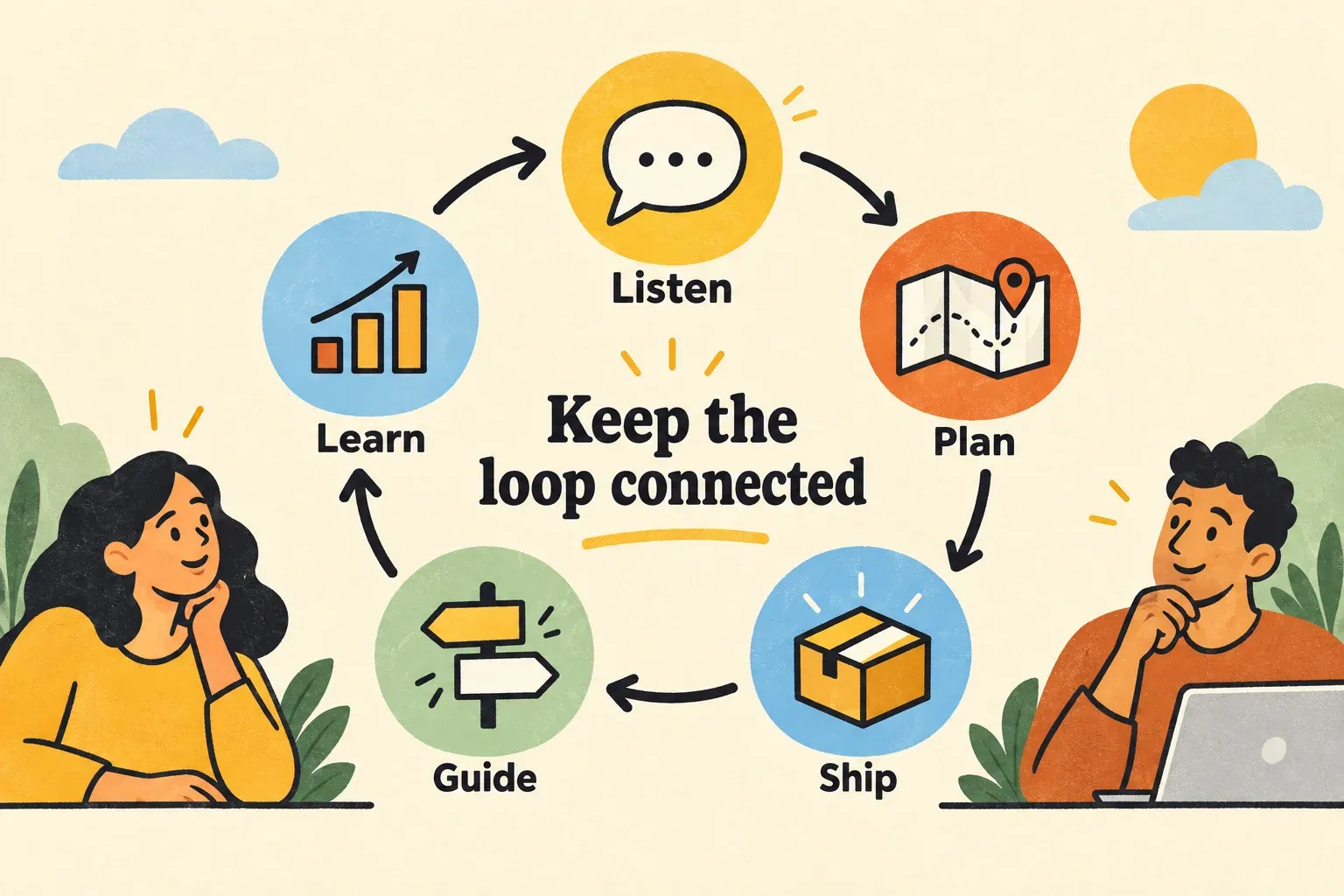
Full growth loop, one workspace
The full growth loop is simple:
- Hear feedback
- Decide what to build
- Announce the change
- Guide users to the new behavior
- Measure adoption
- Learn again
That loop is the center of product growth software, and it is the reason Managani exists. The value is not in one feature on its own. It is in the connection between features.
If you are replacing a fragmented stack, that connection is the point.
Frequently Asked Questions
Is Managani a feedback management tool?
Yes. Managani is a feedback management tool, but it also includes roadmap, changelog, onboarding, and product tracking. That means the workflow does not stop when a request is collected. The team can carry it through to shipping and adoption.
What is onboarding software in SaaS?
Onboarding software in SaaS helps users learn the product and reach activation. Common examples include checklists, product tours, tooltips, highlights, and contextual prompts. In Managani, onboarding is connected to feedback and tracking so teams can see whether it actually helped.
What makes Managani more than a user feedback tool?
Managani goes beyond collection. It connects user feedback to roadmap decisions, release communication, and in-app guidance, then uses tracking to measure whether users adopted the change. That gives teams a full product growth loop instead of a request inbox.
How does customer feedback management help reduce churn?
Customer feedback management helps reduce churn by revealing friction before users leave. When feedback is paired with onboarding and tracking, teams can spot confusing steps, fix blocked workflows, and check whether the change improved retention behavior.
What is the difference between product growth software and product growth tools?
Product growth software usually refers to a unified system that covers the full lifecycle. Product growth tools are often separate apps for feedback, onboarding, analytics, and release communication. If the team needs those jobs to stay connected, a unified platform is usually easier to run.
What is the full story product teams need from usage tracking?
The full story is what users asked for, what shipped, and whether they adopted it. Usage tracking only becomes useful when it is tied to feedback, roadmap decisions, and onboarding, so the team can see the impact of the work they ship.